JIAŌ BĪNG BÌ BAÌ Chinese proverb.
The arrogant army will certainly loose the battle = pride comes before a fall.
READING:
The Night of the Mi’raj by Zoë Ferraris is a fascinating book, not for the murder mystery which is the backbone of the plot, but for the glimpse it gives the reader of life in modern Saudi Arabia.
Nouf ash-Shrawi is a beautiful young woman from a wealthy, well-connected Saudi family living in Jeddah; shortly before her arranged marriage is to take place she goes missing, and the family are frantic. Her brother Othman Shrawi calls in a family friend, Nayir Sharqi, to investigate her disappearance. Nayir, a pious young man, earns his living as a guide taking rich Arabs and foreign visitors to spend time in the desert. Working on limited information he starts searching for her, but within a day or so her body is found in a desert wadi.
Othman asks Nayir to find out how she died, so he goes to the coroners’ morgue in Jeddah to ask for details of their findings. He gets past the guards at the morgue who are there to stop the fanatical Muslims from gaining access:
“Slicing and prodding a dead human body was forbidden by law, and while the government quietly sanctioned autopsies, there would always be vigilantes hunting for un-Muslim behaviour.”
At the morgue he meets up with a woman called Katya Hijazi, who is engaged to marry Othman. Katya is unusual for a Saudi woman as she has a professional job, working in the coroner’s department as a forensic scientist. She tells him that although Nouf apparently drowned, she was pregnant, and so she thinks someone murdered her. The two of them join forces and the subsequent investigation makes Nayir start to question his faith, his friends and the culture of a country which keeps women segregated and gives men such a attitude to them.
Eventually Nayir and Katya solve the mystery of Nouf’s death, but the process has changed them both.
Some of the aspects of life in Saudi Arabia seemed extraordinary. Nayir is always worried about being caught alone with Katya, as they would be immediately be charged with adultery – a woman is never allowed to be alone with a man who is not married to her or a member of her immediate family; for this reason he, like many young Saudi men, carries a fake Misyar
(Certificate of Marriage), which can be hurriedly filled in if the religious police appear.
Women are not permitted to drive in Saudi Arabia, so many of them have drivers/minders employed by their families to take them wherever they have to go. Women’s faces must never be seen by non-family members, and strictly speaking they should also cover their hands and ankles as if seen these could drive a man to lust. When answering a telephone in the women’s section of the Shrawi household, the matriarch waggles her hand in front of the receiver to disguise her voice, in case it’s beauty drive a male caller to impious thoughts.
The restrictions on women make every simple thing warped and difficult for them. At one point Katya is bought an ice-cream cone, but then has a problem getting to a place where she is permitted to lift her burqua in order to eat it before it melts in the intense heat.
The oppressive heat is very much a feature of the book, and as
“Saudi had no bars, no night-clubs, no discos or cinemas. There were underground hang-outs of course, in the homes of the elite….There were even brothels, private residences where men could find prostitutes – all non-Muslim women, since it was haram to sleep with a Muslim whore.”
bored Saudi men spend their evenings driving round and round the streets in their cars, which are at least air-conditioned; needless to say this results in massive traffic congestion in the cities.
There are some really bizarre moments; Nayir has to go with Othman to a clothes souk one evening as Othman wishes to buy a coat for Katya’s trousseau. Whilst at the crowded bazaar, full of rich men buying furs for wives who will never be able to wear them, Nayir turns to see a female flasher – a woman who stares directly at him and then, for a split second lifts her burqua to reveal her naked body.
Zoe Ferraris is an American who married a Saudi Arabian and went to live with his ultra conservative family in Jeddah, so I assume that much of the detail of Saudi life depicted in the book is taken from her experiences there.
The book was an entertaining read, but at the end I put it down with a feeling of profound thankfulness that I do not live in such a society
Rated 4*
RANTING:
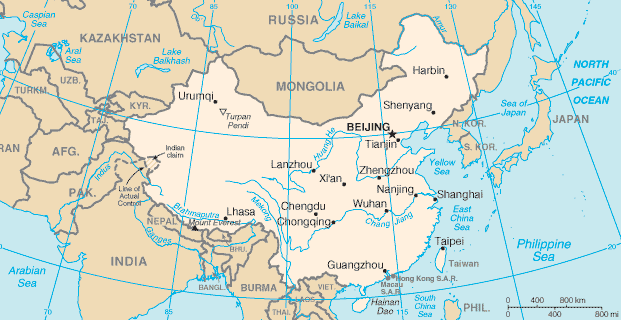
I doubt if anyone could have missed noticing that the Beijing Olympics began today, and I am absolutely furious about the HUGE sums of money that have been spent on sending publicly funded workers to the games this year.
Nearly 600 people in all, including local councillors, government ministers, policemen, civil servants etc - for example Gordon Brown has taken 20 staff with him at a cost of £114,000 (why? we already have a fully staffed embassy in Beijing). The reason being trotted out is 'fact-finding' prior to the London Olympics in 2012. The London Development Agency - an internal Greater London Authority quango set up by Ken Livingston have hired one of Beijing's premier clubs for their exclusive use during the game at a cost of £2.5 million plus. This is all stuff and nonsense, most of these people won't be finding any facts, and anyway, if Labour is voted out of office at the next election (which many political pundits seem to think very likely) none of these official, government ministers etc will play any part in the London Olympics. Lets be real, for most of these people it is a jolly at the taxpayers' expense.
However, I reserve my real fury for the BBC who have spent £3 million on taking 437 staff to Beijing, that is 124 people more than the 313 UK athletes taking part in the games. If as a result the viewers and listeners were getting some incredibly special coverage it might, it just might, warrant the expenditure, but we just going to have the usual gang of suspects commentating on the sport, and a few other BBC apparatchiks droning on as usual about the 3 Ts (Tiananmen, Tibet and Taiwan) and considering themselves very liberal and committed to freedom of expression. Despite all this expenditure, this morning's 'Today' programme on BBC Radio 4 (for those who don't live in Britain, this is THE daily current affairs programme, and all opinion makers listen to it or are on it) had the most spectacular piece of nonsense about why the games were commencing at 8pm on 8th August. They wheeled in some lady numerologist who wittered on about the number 8 representing the word China in numerological terms, she hadn't got an f***ing clue why the Chinese Olympic Committee had chosen that date and time. As any fule no, the number 8 is considered very, very lucky in China, and has been for millenia. This is because the word for 8 in Mandarin is bā, which sounds very like the word for wealth/prosperity/good fortune which is fā. Also, 8 has a perfect symmetrical shape both horizontally and vertically which indicates that it is in balance. So to start the games at 8.08pm on 08/08/08 is very propitious for China, the Chinese, and Beijing. So the Beeb has spent all that money, sent all those staff out to Beijing and they couldn't even get a simple thing like the number 8 right - what hope is there for any other information they feed us being accurate?
RECIPE:
In the last month or two I've been slipping into the bad habit of buying ready-made salad dressings. It is such a waste of money, as it only takes a few minutes to make a dressing there is really no excuse for buying them, I've just been lazy and seduced by the huge variety of dressings that you find on supermarket shelves. Having admitted the error of my ways, I am now determined to make my own again, starting with Thousand Island dressing which I always loved as a child. Because of it's name, I'd always assumed that the dressing was inspired by a group of tropical islands, but when I googled it I discovered that there is an archipelago of islands which straddle the US/Canada border in the St Lawrence River at the north east corner of Lake Ontario. Sometime in the early 1900s the recipe was passed from Sophie Lalonde, who had a hotel nearby, to a famous actress whose summer home was in the Thousand Islands, and it was she who named the dressing.
THOUSAND ISLAND DRESSING
75ml mayonnaise
75ml crème fraiche (or sour cream)
60ml tomato ketchup
Juice of one lemon (approx 60 ml)
Dash of Worcestershire Sauce
4 Tablespoons finely chopped green pepper
2 Tablespoons finely chopped red onion
1 Tablespoon chopped flat-leaf parsley
1 Tablespoon sunflower oil (or similar)
Good pinch cayenne pepper
Good pinch salt
Combine all ingredients in a bowl and whisk together or give a short whiz with a hand-held blender until all is well combined. Not too long if you use a blender as you don’t want the pepper and onion totally amalgamated.
Pour into a bottle or jar and chill in the fridge. Remove 5 minutes before using.
Will keep for 2 weeks in the fridge in an air-tight container.