READING:
I have been sifting through my bedroom bookshelves, which mostly have paperbacks, and have become horribly clogged up and muddled -originally I had the books in alphabetic order by author. Anyway, I have come across some old favourites and have started reading them again. One of these was a book I was bowled over by when I first read it.
Riddley Walker by Russell Hoban is a truly extraordinary and brilliant book. Not an easy read, because of the way Hoban has modified the English language, (it helps to read it aloud). When I first read the book in my early twenties, I had no knowledge of the legend of St Eustace, nor of the Green Man mythology, both of which feature in this book. You don't have to know about them to make sense of the story, but it helps.
It is set somewhere in southern England far into the future, when modern life as we would recognise it has vanished following what was presumably some nuclear apocalypse which had occured long before the book even begins. The narrator is Riddley Walker, a twelve year old boy describes life in what is a peasant society living a medeiaval existance. All previous knowledge has been lost, even the events which changed the world have become a faint folk memory.
At the start of the book three important th.ings happen to Riddley. On his naming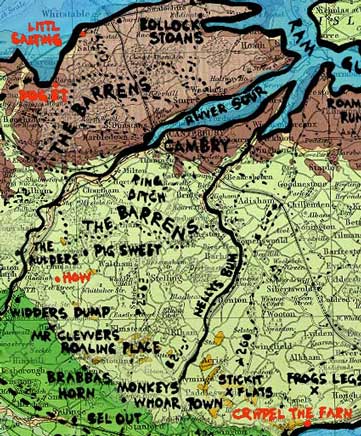 day (the day he turns twelve) he kills a wild boar, he sees the leader in a pack of dogs is watching him - ever since the nuclear holocaust, dogs have been the sworn enemies of man,- and three days later his father is killed in an accident, leaving Riddley to inherit his father's role in the community.
The book is haunting, unsettling and terrible, but there are instances of humour and the natural spirit of mankind bubbles up all the time.
Re-reading the book I was struck by the fact that it was written in 1980 - many years before text-messaging (SMS) had been invented, yet much of the language Russel Hoban has invented is incredibly like txt talk. I think this might make the book more accessible to young people today who are used to communicating using this type of language.
RANTING:

That is what HMQ said in her speech opening the 2006/07 parliamentary session three days ago. Of course, she didn't write the speech herself, it was written for her by government apparatchiks with input from all the Departments of State. One of the biggest of these departments -if not THE biggest - is the Home Office, the department which is responsible for our police, our prisons, and our justice system.
So they want victims to be at the centre of the criminal justice system do they? Oh yeah? Well in that case, why, in the very same week, did the Home Office decide not to defend the case being brought by a group of drug addicted criminals? A group who were forced to go "cold turkey" when they were imprisoned, and who alleged that their human rights were violated as they did not give consent, and that their negligent treatment amounted to assault.
Withdrawal from using drugs, especially 'hard' ones like 'crack' or heroin, is frequently believed to be more difficult than it actually can be. Whilst quick withdrawal from certain drugs (alcohol, barbiturates and tranquillisers) can be dangerous, withdrawal from heroin may be comparable to a nasty bout of flu. Undesirable, but hardly life threatening. (The real difficulty for most addicts, is not coming off the drugs, it is staying off them). It seems extraordinary that this group was thought to have substantial grounds for making their claim.
The Home Office were supine in failing to defend the case with the utmost vigour, and deciding to make an out-of-court settlement. An out-of-court settlement which will give 197 prisoners a payment of £3500+ each. An out-of-court settlement which comes straight out of the taxpayers' pockets.
These people are in prison because they were found guilty of having committed crimes, what settlement are the victims of their crimes getting?
I will have to go and have a lie-down, my blood is boiling.
RECIPE:
The nearest I've ever got to Sweden is IKEA in Wembley, but there is a dish from Sweden that I like very much. It goes by the unlikely name of Jansson's Temptation. I first tasted it at a restaurant called Anna's Place in north London many years ago, and eventually I tried making it myself. Basically it is a potato, onion and anchovy gratin, bathed in cream and baked until meltingly soft and unctuous. The name comes from a Swedish opera singer, at the end of the 19th century who liked cooking up a little something for supper after the opera, something with which he could tempt ladies of the chorus, and this was his signature dish. He was called Pelle Janzon, but eventually changed his name to Jansson as he became more successful (I'm not too sure whether his success was as a singer, or as a lothario). It seems to be a dish that the whole of Sweden eats at Christmas time, but I think it is great on a cold winter evening when you want to eat comfort food, but something a little different.
JANSSON’S TEMPTATION
6 medium sized potatoes
2 medium onions
3 tablespoons butter
15 anchovy fillets (approx 2 tins)
75ml single cream
75ml double cream
2-3 tablespoons dry breadcrumbs
Pre-heat oven to 200°C
Peel the onions, cut in half and then slice very, very thinly. Melt one tablespoon of butter in a frying pan and gently sauté the onion slices for a few minutes.
Drain the anchovy fillets, rinse and pat dry, then cut each one in half length-wise.
Mix the two creams together in a saucepan over gentle heat, do not let it boil.
Peel and grate the potatoes. You should work quickly now as the potato will discolour quite rapidly.
Put a layer of grated potato in the gratin dish, cover with a layer of the sliced onion, then place a lattice of anchovy over the onion; repeat the layers of potatoes, onion and anchovy, ending with a layer of potatoes. Smooth the top layer, and press down firmly with the palm of your hand.
Pour the warm cream over the potatoes. Sprinkle the dry breadcrumbs over the top and dot with the remaining butter.
Bake in the oven for 1 hour.