Showing posts with label pork. Show all posts

Saturday, February 07, 2009


THE AGEING PROCESS HAS YOU FIRMLY IN ITS GRASP IF YOU NEVER GET THE URGE TO THROW A SNOWBALL.


READING:


Nicole Mones is an American who lived and worked in the textile business in China for 18 years, and she really knows the country and all its contradictions very well indeed. In her latest book, The Last Chinese Chef, she has entwined a modern love story with the story of China’s culinary culture.

Maggie McEllroy is an American food writer approaching her fortieth birthday when her husband is tragically killed. For many months she is overwhelmed by grief and unable to function properly, and when she is contacted by the law firm for whom her husband had worked to say that a paternity case has been lodged against his estate, on behalf of a five year old child in China, she is even more devastated. She is asked to go to Beijing to sort things out. The editor of the gourmet food magazine for whom she writes urges her to go, and commissions a series of articles on food in modern China.

The Beijing Olympics are looming, and the authorities in China have decided to hold a competition to choose the very best chefs to be part of the national cooking team over the Olympic celebrations. Thus it is that Maggie meets Sam Liang a Chinese/American chef who is last in a family line of famous chefs dating back to the days of the Imperial Court. His father had fled China during the Cultural Revolution and ended up in the USA.

Over a few weeks Maggie and Sam fall in love; and as Sam prepares to cook for the banquet of a lifetime, both Maggie and the reader learn about the place food holds in China’s history, its gastronomic philosophy, and how fine cuisine can be elevated to an art form.

To do this, the author has used the device of a book-within-a-book. Each chapter starts with a quotation from 'The Last Chinese Chef' purportedly published in 1925 by Liang Wei, Sam's grandfather - the opening chapter begins with:

"Apprentices have asked me, what is the most exalted peak of cuisine? Is it the freshest ingredients, the most complex flavours? Is it the rustic, or the rare? The peak is neither eating nor cooking, but the giving and sharing of food. Great food should never be taken alone. What pleasure can a man take in fine cuisine unless he invites cherished friends, counts the days until the banquet, and composes an anticipatory poem for his letter of invitation?"


Over the years I have eaten many meals in China, but it was only from reading this book that I began to grasp some of the ancient thinking behind the various styles of cooking and the choice of foods that I have been served.

The book is a must for anyone who enjoys Chinese food, or is interested in China.


Rated: 5*


RANTING
:

I can't remember how old I was when I first learnt the old sea shanty "What Shall we do with the Drunken Sailor?" though I do remember singing it at primary school in Africa. It was also in the family repetoire of songs that we sang to relieve the boredom of long dusty car journeys. However, some dim spark at Bookstart the UK charity which "aims to provide a free pack of books to every baby in the UK, to inspire, stimulate and create a love of reading that will give children a flying start in life", has decided that the song is not suitable for children.

In addition to supplying books, they also organise Bookstart
Rhymetimes at local venues such as libraries. These are regular get-togethers for parents, babies and toddlers to sing songs and rhymes. In the Bookstart song sheet, the words "Drunken Sailor" have been replaced with the words "Grumpy Pirate" - removing any references to alcohol, presumably because the idea of a drunken sailor is just too inappropriate whereas grumpy pirates - like the murderous Somalis who have been terrorising the coast of east Africa, capturing oil tankers, container ships and the like - are considered acceptable. Of course, once you remove drunken sailors from the song you have to remove all the follow-on lines . "Put him in the brig until he's sober...Give him a hair of the dog that bit him...Hoist him to the yardarm with a running bowline" and my favourite, "Shave his belly with a rusty razor" are all too violent for the little darlings to lisp.

Therefore they have been replaced with lines such as "Tickle him till he starts to giggle" and "Do a little jig and make him smile". What the hell is this bowdlerised rubbish?
Sea shanties are part of the heritage of a maritime nation, we will be a nation of lily-livered wimps if this sort of PC nonsense continues.

I'd like to get the Bookstart censor then I'd Shiver his Timbers.

Heave Ho and up he rises,
Heave Ho and up he rises Heave Ho and up he rises Early in the morning! Scratch his back with a Cat-o'-nine-tails Early in the morning!


RECIPE:

After reading Nicole Mones book (see above) I felt I should make something Chinese,
but with the cold snowy weather we're having I fancied something a little more substantial than a quick stir fry. This dish is a classic in China, I should think every household has their own variant of the recipe, in fact I have at least four versions , this one is taken from Fuchsia Dunlop's book Sichuan Cookery, slightly tweeked by me. It is a particularly apposite dish to make at the moment, as the sainted Jamie Oliver is on TV these days banging on about eating British pork and particularly encouraging people to use the cheaper cuts such as belly.

HONG SHAO ROU - Red Braised Pork

Serves 2 as a main course, or 4 with two or three other dishes as
part of a Chinese meal.
This re-heats very well on the second or third day, so can be made in advance.


500g streaky belly pork with skin on
Large piece of fresh ginger, unpeeled

2 spring onions

3 tablespoons sunflower oil or similar (NOT olive oil)

500ml chicken or vegetable stock

1 tablespoon dark soy sauce
2 tablespoons Shaoxing wine (if you don't have this you can substitute dry sherry)

Half teaspoon salt

3 heaped tablespoons soft brown sugar
1 whole star anise

1 piece cassia bark (or use half a cinnamon stick)


Bring a large pan of water to the boil; when boiling, put the pork belly in and cook for 3-4 minutes then remove to a chopping board.
After a minute or two, when cool enough to handle, cut the pork into 3-4cm chunks making sure that each piece has a layer of skin and a mixture of meat and fat. Use something heavy to slightly crush the piece of ginger, then cut the spring onions into 3 or 4 pieces. In a flameproof casserole, heat the oil until it is almost smoking and then add the pork chunks (take care to stand back as you do this as the hot oil tends to spit out at you) and stir fry them for a few moments before adding the stock, sugar, soy sauce, wine, salt and spices. Stir together and bring to the boil. Simmer, half-covered, over very low heat for about two hours, stirring now and then to prevent it sticking. The meat should become a reddish brown and very tender, and the sauce reduce by half and be dark and glossy.
Serve with plain steamed or boiled rice, and garnish with finely chopped spring onion.


Friday, February 01, 2008

WHAT WAS THE BEST THING BEFORE SLICED BREAD ? I'VE OFTEN WONDERED...
Answers on a postcard please.


READING:

Amongst other books I was given for Christmas were two slim volumes from a new series, Great Journeys, published by Penguin Books. There are twenty books in the series, each consisting of an extract from a larger work by renowned writers from Herodotus and Mas’Ūdī to George Orwell and Ryszard Kapuściński and covering journeys on every continent.

The two books I was given were #11 In the Heart of the Amazon Forest by Walter Henry Bates, and #14 Adventures in the Rocky Mountains by Isabella Bird.

Bates was one of the major zoologists of the Victorian era, and spent eleven years living on the Amazon where he gathered 15000 specimens, mostly insects. This extract, from his book The Naturalist on the River Amazon, tells of his time staying at a place where the various river systems of the Amazon all meet. He describes the lives of the various tribes of Amazonian Indians who live there, how they use blow-pipes for hunting, what they eat and drink, and how they have interacted with the colonials who are spreading slowly through the forests. His descriptions of the wildlife he encounters are so vivid, I could really SEE the various ants, jaguars, turtles, alligators and birds that he writes about.

Isabella Bird was also a Victorian traveller although she was not a zoologist. She was the daughter of an English clergyman and was sent off to Hawaii and America to improve her poor health – given that this was in 1854 it seems a rather drastic remedy, but seemingly it did the trick, after she had climbed the worlds highest volcano (as one does) she set off, in 1873, for Colorado - which in those days was untamed territory, still occupied by Red Indians (or Native Americans as they prefer to be called now) and outside the boundaries of the fledgling union of States which has become the USA.

The book consists of a collection of some of the letters she wrote to her sister Henrietta who was back in England, describing the incredible beauty of the country she was riding through, the magnificence of the Rocky Mountains and the wild pioneers who are settling the land. She tells of encounters with a grizzly bear, beavers, elk, a half-crazed settler who had become a cannibal, and describes the the trees and plants which grow in abundance and are all strange to her. A formidable woman in every sense of the word!

I found these books absolutely enthralling, and because of their size I was able to tuck them into my handbag, so passing tedious time standing in queues at the supermarket and post office, mentally transported to north and south America. When I announced that I intended to collect the entire series, my DD and her BF were delighted, as there are 18 more, and that should solve the perennial question of what to give Mum for her birthday and Christmas for some years to come!

Rated 5*


RANTING:

I have only dialled 999 on three occasions, once when a neighbour’s teenage daughter inadvertently set fire to her bedroom when her mum was out, once to call for an ambulance when a motorcyclist was hit by a car in front of me, and once, at 3 a.m. when I was woken by the sound of breaking glass and saw two men breaking into the house opposite. On every occasion the appropriate service arrived fairly quickly (fire speedily doused, motorcyclist scooped up and blue-lighted to A&E to be treated, burglars escaped but were arrested two weeks later).

In each case I was confident that dialing 999 was the correct thing to do. You dial 999 when there is an emergency. That is an E.M.E.R.G.E.N.C.Y. not when you have a problem. I thought everyone knew that, come on, its basic knowledge isn’t it? Apparently not. South Wales Police have just announce that they are changing the words they use when answering 999 calls. Up to now you would have heard “How can I help you?” from now on they will be saying “What is your emergency?”. They have decided to do this because they are getting so many time-wasting calls such as the woman who dialed 999 and said "My husband has the TV remote and won't let me watch EastEnders”, and the man who called to say "Can you come round and take my mother-in-law away? She has been here for 18 days".

Pound to a penny this sort of ridiculous behaviour is happening all over the country and not just in South Wales, and every time some moron makes a call like that, the rest of us who might really need the emergency services are put in jeopardy if we can’t get through because the lines are busy.

I am not a great one for demanding new legislation, but modern telephony makes it possible for calls to be traced, and anyone who makes one of these utterly stupid calls should be hauled over the coals and given a hefty fine


RECIPE:

In the 70s when I was newly married and just beginning to flex my muscles in the kitchen, Beef Stroganoff was often on menus, but I couldn't afford the fillet steak that the recipe usually demanded and so made a version of the recipe using pork. Of course it is not the 'classic' dish which was apparently created in the 1890s by the chef of a Russian aristocrat, Count Pavel Alexandrovich Stroganov*, but it was jolly tasty anyway, and the other night I suddenly had the urge to make it once more. This recipe is more or less the same as the original one I used all those years ago, but with one addition which I took from the recipe given by those fantastic cooks, The Two Fat Ladies, namely some gin to flavour the pork.

PORK & MUSHROOM STROGANOFF

Serves 4

500g pork tenderloin (fillet)
200g mushrooms
Dash of sunflower oil
2 tablespoons butter
2 medium onions

1 teaspoon Paprika
6 tablespoons gin
150mls sour cream or crème fraiche
Salt and pepper

Handful of parsley, finely chopped for garnishing.

Cut the pork tenderloin across the grain into 1cm wide discs.
Finely slice the mushrooms.
Peel the onions and cut in half from top to bottom and then slice in the same direction to make fine slices. (This makes long slivers of onion rather than half-moon shaped slices)

Heat the oil and butter in a large frying pan and sauté the pork slices in batches turning regularly so they are slightly browned. As they are done remove them from the pan and keep warm. When all the pork is done, add a little more oil to the pan and then sauté the onions until quite soft and just beginning to colour then add the mushroom slices and continue cooking until they are soft.
Remove the onions and mushrooms from the pan.
Return all the pork to the pan, together with any juices, add the gin and heat gently for a few minutes. Then use a long match to set light to the gin, and whilst it is flaming baste the pork with it. Season with salt and pepper, and then stir in the paprika.
Lastly, stir the crème fraiche into the pan and continue cooking for a few minutes until it is bubbling gently.

Serve, sprinkled with parsley, on a bed of noodles or with creamy mashed potatoes

*BTW I've just discovered another recipe which takes Count Stroganoff's name - a cocktail of vodka, white creme de cacao, and lime juice - sounds yummy, I intend to try it sometime.

Friday, February 02, 2007

FEBRUARY BRINGS THE SNOW, MAKES OUR FEET AND FINGERS GLOW...
Not this year it doesn't, this is the mildest winter I remember since I came here from Africa umpteen years ago; thought provoking, worrying, what IS my carbon footprint?

READING:

So Many Ways to Begin by Jon McGregor was listed for the Booker Prize in 2006. I read and enjoyed his first novel and I think that this, his second book, is even better.

This is the story of a life, of a marriage, and of beginnings. It starts with David as a small boy growing up in Coventry in the late 40s and 50s, he is fascinated by found objects, and spends hours grubbing things up from bomb-sites which he keeps in his carefully arranged collection. He loves museums, the smell of them, the idea of keeping things which provide people with a link to the past, and he is determined to work in a museum when he grows up, but is determined that “his” museum will have no replicas, nothing “made-up”, as he says that you cannot learn history from anything made up as it isn’t true, it’s a lie.

And sure enough, he becomes a curator in the first museum in Coventry. On a trip to a museum in Aberdeen he meets Eleanor, and whilst courting her he inadvertently discovers that he is not the natural child of his parents, he is adopted. However, the adoption was never official, and indeed his late 'father' had always assumed David was his child, the only people who knew otherwise were his adoptive mother and an old family friend. This information rocks him to the core. His life has been based on a lie, he is not who he thought he was. He takes out his anger and distress on his mother, refusing to speak to her for many weeks and causing her great unhappiness. Eleanor abandons her family in Scotland, she and David marry and settle in Coventry, where she become increasingly depressed; David discovers that her beginnings are not ideal either; she had a very difficult childhood, suffering constant maternal abuse, both mental and physical. Eleanor begins to suffer from severe depression which dogs her off and on all her life. Time passes and they have a daughter in whom they both delight, but David’s desire to know about his birth and his true beginnings eats away at him. The lack of knowledge of who he really is comes to the fore when his daughter Kate has to do a family tree as a school project. After their daughter leaves home David decides to make a serious attempt to trace his birth family, and through the internet he makes contact with a woman who thinks she maybe his half-sister. He and Eleanor go to Ireland to meet this woman, and to meet her mother who is now an old woman. To the sadness of both he is not the son she gave up, and she is not the mother he is seeking.

Perhaps the beginning is not what he thought it was, perhaps his beginning was when his adoptive mother, took him in her arms. McGregor is marvellous at making the reader look at the minutiae of life, and ponder on how small chains of events can have large personal consequences. Cause and effect. The same idea was explored in the film “Sliding Doors” with Gwyneth Paltrow. We can all look back at our lives in that way…if I hadn’t missed that bus I wouldn’t have met… because I was on a business trip I discovered…and so…two minutes later and I’d have been in that motorway pile-up…one could go on and on, after all, there are so many ways to begin.


RANTING:

Her Majesty’s Government, Gordon Brown in particular, don’t think that the airlines are doing their bit for the environment, and to help reduce CO2 emissions caused by burning fossil fuels. So what have they done, they have increased the Air Passenger Duty as of yesterday. Who pays APD? Not the airlines that’s for sure, it would reduce their profits; no, no it is each and every passenger who will pay. The airlines will just act as glorified Tax Collectors for the Treasury

The various Government spokespersons can go on TV and radio as much as they like making self-righteous speeches about this being part of the Government’s environmental strategy to help stop global warming, and trying to make us feel all warm green and fuzzy about them, but it won’t wash, at least not with me. This is yet ANOTHER stealth tax

Why does our Government not take a lead and make the airlines pay tax on the fuels they use, that would focus their minds on the environment. This increase in the APD merely taxes individuals (who are already paying several sets of taxes in order to take a flight), and puts money into the Treasury’s big pot. They might use it for environmental causes, but then again they might not, the money is not being specifically ring fenced.

RECIPE:

I've been in court all day - Family Proceedings; emotionally very draining, so it's lucky I prepared dinner yesterday evening as my darling daughter and her squeeze are with us tonight en route to skiing/snowboarding in Avoriaz - is there enough snow what with this mild winter?

PORK & CHORIZO CASSEROLE – SPANISH STYLE

Serves 6

Pre- heat oven to 140°C

1 Kg lean pork, cubed
250g chorizo, peeled and cut into chunks (do NOT use pre-sliced chorizo, ask for cooking chorizo)
2 medium red onions peeled and thickly sliced
3 cloves garlic, peeled and thinly sliced
400g tin of chopped tomatoes or tomato passatta
1 tin (420g) chickpeas, drained
300g roasted red peppers in brine or oil, drained (I buy these in a local Greek Cypriot greengrocers)
250ml white wine
12-18 pitted black olives
5-6 sprigs fresh thyme
Saffron, generous pinch of strands
2 Tablespoons wine vinegar
Salt and Pepper
1 Tablespoon olive oil.

Put the cubed pork, chorizo, red onion, and garlic into a large flame proof casserole. Cut the drained red pepper into large pieces and add them, together with the wine, passatta, olives, and chickpeas. Put the strands of saffron into a pestle and mortar (or a cup) and grind to make a powder, pour the vinegar onto the saffron, stir, and add the mixture to the casserole. Drizzle the olive oil over everything, season well with salt and pepper and stir the whole lot together with a wooden spoon. Place over a medium heat and bring up to simmering point. Transfer the casserole to the pre-heated oven and cook for 1½ -2 hours until the pork is tender and everything has amalgamated. Can be kept for 24 hours if needed before heating again and serving.

Serve with rice and/or crusty bread with a green salad – and a large glass of Rioja!


Tuesday, August 22, 2006

Up betimes and at my blog; a busy day lies ahead - as usual I seem to have bitten off rather more than I can chew - which is why I am sitting hunched over a keyboard in the pearly light of dawn, mug of coffee to hand, typing this!

READING:
Friends gave me a copy of “Suite Française” by Irène Némirovsky as a birthday present, and I read it this week. (Curiously, my mother and my sister had each been given copies of the same book for their birthdays.)
It is not a complete book, the author, a Russian Jewess living in France, who had already written several acclaimed novels started writing it in 1941. She intended the finished book to be in five parts, like an orchestral suite of music, but was seized by the Nazis and died in Auschwitz in late 1942, having written only two of the five parts. These two parts, together with her copious notes on what she was writing and her planning for the remaining three parts of the book, miraculously survived in a small suitcase which her two small daughters had with them when they fled the Nazis and went into hiding. As adult women, Iréne Nèmirovsky’s daughters decided to transcribe what they had thought was her daily journal, and discovered that it was a book, or part of a book. “Suite Française” is a collection of the two parts she had written, all her notes, letters between herself and her publishers and friends about her books, and then the frantic correspondence between her husband Michael Epstein and anyone of influence in occupied France whom he thought could save his wife after she had been arrested.
Her writing is exceptional, light, delicate and intimate. She conveys the horrors of the Nazi invasion of Paris so well that you live through the nightmare and the panic as you read.
Her account of rural life under the German occupation is superb; she views everything and everyone with an unsentimental clarity. It is not too exaggerated to say I found her writing on a par with Flaubert. What a terrible loss to French literature.
I am quite unable to do justice to this book in a few words, suffice to say I thought it was simply wonderful, and urge everyone to read it, particularly teenagers. It is a beautiful and chilling reminder of what happened in the mid 20th Century, and what we must guard against ever happening again
.

RANTING:
There has been much huffing and puffing about profiling in the past week. At present all airline passengers are considered equally likely to be terrorists and are all subjected to the same treatment whether they are little old ladies, frequent business flyers, or young asian men in Islamic dress. Consequently the security queues at airports and elsewhere are taking longer than ever. Personally I think this is a crazy way to proceed. Last week the cartoonist Matt who draws for the Daily Telegraph had a brilliant cartoon which sums it up; I hope he and they will not mind me including it here.
We spend our normal lives catagorising things, situations and people, why should this not apply to security too?
Of course security proceedures should not rely solely on profiling, but it should certainly be one of the methods in use. The Muslim Council of Britain is vehimently opposed to any form of profiling, saying it would not be fair, and would antagonise the innocent asians who were subjected to it. That might be, but at least they would be safer. The other arguement put forward by the MCB is that the terrorists would switch to recruiting tall blonde Scandinavian women to carry their bombs or whatever. Oh really? and how are they going to do that ?
Many groups in our society have been at the forefront of profiling - a case in point is the situation some young male cancer sufferers have found themselves in. Chemotherapy has caused hair loss, and bouncers at clubs and gigs in Birmingham and elsewhere have been refusing to let them in, assuming they are skinheads and will cause trouble. Have they been whining about it not been fair that profiling young bald males as probable skinheads has caused them to miss out on some relaxation and fun? no, they have found a way to sort it out. Take a look at this example of a card that they now carry to persuade the club security teams that they are hairless because they have cancer.


RECIPE:
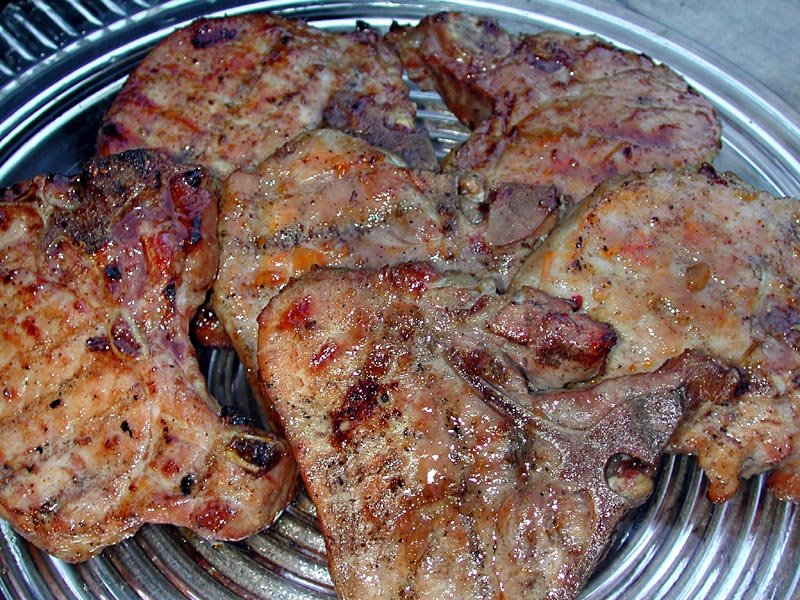
This is a great recipe for a mid week supper as I can prep it the previous evening if I am in court the next day -and come home knackered - it is all ready to cook.

JERK PORK CHOPS

4 thick pork chops

1 onion peeled and finely chopped
4-5 spring onions, finely chopped
4 cloves garlic, finely chopped
2 teaspoons fresh Thyme
1 red chilli, deseeded, finely chopped
1 level teaspoon cayenne pepper
½ teaspoon grated Nutmeg
2 teaspoons salt
1 ½ teaspoon sugar

Olive oil

Place chops in a shallow dish.
Whiz all the remaining ingredients except the olive oil in a blender or food processor to make a purée.
Mix 2 heaped tablespoons of this mix with 1 tablespoon of olive oil. Spread the mixture over the chops, cover the dish and leave to marinate for at least 6 hours or overnight.
Grill or braai the chops for 10-15 minutes, turning once, until cooked through. Garnish with a little chopped red chilli or fresh thyme. Serve with rice and peas.

The remaining jerk marinade keeps well in the fridge for at least one week.