Showing posts with label soups. Show all posts

Saturday, June 09, 2007

'WHATEVER WOMEN DO THEY MUST DO TWICE AS WELL AS MEN TO BE THOUGHT HALF AS GOOD. LUCKILY THIS IS NOT DIFFICULT.'

Charlotte Wilton - 1963


READING:

About a year ago a friend who lives in France recommended ‘Hunting and Gathering‘ by Anna Gavalda to me, I wrote down the details and promptly lost the piece of paper I’d noted them on. Typical. So it was with whoops of delight that I spotted a copy on another girlfriend’s kitchen table and shamelessly asked to borrow it immediately.

It is a delightful book, tender, wistful, and funny, and concerns the lives of four misfits in French society whose lives become entwined. Camille Fauque is a 26 year old artist who is virtually anorexic, hasn’t drawn or painted for some years and works nights as a cleaner in Parisian office blocks. Philibert Marquet de La Durbellière (aka Philou) is a shy, stuttering aristocrat with obsessive-compulsive tendencies who sells old postcards outside Parisian museums. Franck Lestafier is a feisty working-class chef who feels terrible guilt about his ability to care for his elderly grandmother who he has to put into an old people’s home. Paulette, his grandmother, becomes the fourth member of this unlikely quartet of characters, and eventually all four are living together in a vast ornate Parisian apartment which Philou is caretaking for a family trust.
A simmering sexual tension
develops between Camille and Franck, but the other two seem oblivious to it, even when the two start sleeping together. Philou has to deal with and ignore the scorn of his arrogant father, and find self- confidence in what he does and those he loves. Paulette has to come to terms with the fact that she can no longer live in her beloved house and tend the garden which has meant so much to her, and that she is slowly but steadily coming to the end of her life even though there is still much to be enjoyed on a daily basis.
Gavalda weaves all four characters into a fascinating ensemble, never sentimental or mawkish even when bringing the whole to a satisfying conclusion
In addition to characters who I really found interesting, I felt that I was getting a more realistic picture of modern France, unlike some other, usually British, writers writing about the country.

Allison Anderson has done a wonderful job translating the book into English, the language is so natural and feels so fluent that unlike some other books translated from French I completely forgot it was a translation.

I am not surprised that the book has already been turned into a movie by Claude Berri starring Audrey Tautou.

Rated 4*


RANTING:

I've never given a great deal of thought to the Venice Biennale; that said, I'm not a complete philistine, I draw and paint, visit museums and galleries ,and even got a distinction in History of Art at Matric many moons ago. However the Venice B has always been one of those events I've read about in the papers that has sparked mild interest for about ten seconds.

A day or two ago I read that Tracey Emin ( she of the unmade bed) was this year's British entry into this prestigious (pretentious?) modern art festival . Oh fine, quite interesting, so what.

Today I discovered that we, the British Taxpayers, have paid £250,000 for her work for this show. Hells bells, thats a lot of dosh for stuff that we won't even own at the end of the whole shebang.

According to The Times: "The British taxpayer has paid £250,000 for the show, staged by the British Council. But profits from any works sold, for between £12,000 and £325,000, will go to the artist and her dealer, Jay Jopling, of the White Cube. Having been chosen for the Biennale her prices will rise dramatically."

If we were show-casing unknown artists who required funding to have the honour of representing the country at one of the world's most celebrated art festivals I would probably say "fine, lets go for it". However I'm not so sure I feel fine about funding one of our most financially successful modern artists to do the same, knowing she will make a whole lot of extra money for herself out of it into the bargain - and the British taxpayer gets what?......

oh alright then, obviously I AM a philistine.


RECIPE:

Cold soups are not everybody's cup of tea ( if you will excuse a mixed metaphor). Personally I can take 'em or leave 'em - with two honourable exceptions which are so delicious I can never resist - Gazpacho and Vichysoisse. Vichysoisse was the first cold soup I ever tasted; my mother used to make it regularly as a dinner party starter - and in the heat of central Africa it was always a winner. Cool, velvety, palest green with a subtle swirl of cream and a few freshly chopped chives, it was - and is - elegance personified.
I vaguely remember being told by Mum that it was an American soup, but never paid much attention. The name sounds so French that I'm sure many people think it is a classic French recipe. But Mum was correct, it IS an American soup; Louis Diat the Chef at the Ritz Carlton in New York invented it in the 1920s and called it Crème Vichysoisse Glacée. Basically it is a sieved leek and potato soup, thinned down with cream and given a garnish of chives. Diat named it in honour of the spa town in the Auvergne close to his original family home in France.

VICHYSOISSE

Serves 6

1 litre chicken stock
4 leeks, cleaned, trimmed and finely sliced

6 spring onions, cleaned, trimmed and finely sliced

500g potatoes, peeled and finely diced (if you can use Jersey Royals, so much the better)

Salt and pepper

280 ml milk

280 ml double cream

Chives for garnish, plus a little extra cream.


Put the leeks, spring onions and chicken stock into a large pan and simmer together for 15-20 minutes; then add the diced potato and salt and pepper. Cook for a further 20 minutes until the potato is soft. Use a hand blender, or liquidiser, and whiz the soup to a puree. Pass the soup through a sieve, add the milk and cream, check the seasoning and re-heat . Sieve the soup for a second time. Pour into a container and chill in the fridge until wanted - at least 4 hours.
Serve in cold bowls with a swirled teaspoon of cream and a garnish of chopped chives. If it is a very hot evening, an ice cube can also be floated in each bowl at the last moment.

This is good served with Melba Toast.

Saturday, March 17, 2007

A BOOK OF VERSES UNDERNEATH THE BOUGH,
A Flask of Wine, a Loaf of Bread - and Thou
Beside me singing in the Wilderness -
And Wilderness is Paradise enow.
from 'The Rubiayat of Omar Khayyam'


READING:
I’m a sucker for encyclopedias, directories, dictionaries and all other books which gather bits of information together and catagorise them. I also love cooking, eating and reading about food. So when I saw this on the new books pile in my local library I simply couldn’t resist borrowing it, with, I must admit a view to deciding whether to buy a copy for myself when it came out in paperback.
The Compendium of Nosh by Jack McLean looked as though it would be just my sort of thing. Alas, not. As it says on the jacket blurb, the author is “opinionated, idiosyncratic and completely unreconstructed”. This book told me more about Jack McLean than about anything else, and I’m not sure I am terribly interested in him and his views, certainly not enough to buy the book – and I certainly wouldn’t recommend it to any of my foodie friends. To give you some idea of the style of writing, and the appalling level of information provided, here are some examples quoted in their entirety:
Darj
eeling:This expensive tea is grown in the snowy foothills of the Himalayas. It is much exported to Russia.
Knaildlich:
These dumplings made from matzo meal are part of a traditional Jewish Passover soup. They are dreadful.
Mulled wine or ale:
Wine or beer heated up with sugar and spices. It is traditional at festive occasions and is thoroughly unpleasant.
If you are at all interested in food, its origins, regional differences in foods and how we use ingredients, don’t bother wasting your time on this book. The author, with an arrogance that is breathtaking, styles himself The Urban Voltaire.

Rated: 1*


RANTING:

A summer picnic (or a winter one for that matter) wouldn't be a proper picnic without a glass or two of wine. And one of the essential items in any picnic kit is a corkscrew, although with the advent of screwcap fixings on wine bottles that isn't quite as vital as it once was. What I will never, never buy - or hope to be served - is a Tulipa, a pre-filled, foil sealed plastic glass of wine. These are the brainchild of a company called Al Fresco who have spent half a million quid "developing the concept". Apparently they are going on sale in the UK in a few months time, priced at £3,75 for a pair. There will be a choice of an Australian red or white wine and a Californian rose.


I can see the clever dick thinking behind this "... imagine that you are going out for a picnic, and you've forgotten the wine, corkscrew, wineglasses. Just pop into a convenient branch of XYZ Boozers Ltd and pick up a double pack of Tulipas" This is a truly ghastly idea and begs so many questions - When will the wine be poured into the glasses? what processes will be needed to foil-seal the glasses, how long will they sit around on a shelf waiting to be sold?


I am not particularly reknowned for my Green credentials, but even I can see that this cannot be an environmentally friendly concept. The "glasses" are plastic and not reusable, the foil seal makes for more waste, and the packaging/production process must use energy rather than conserve it. How much simpler, cheaper, and more eco-friendly to simply open a bottle of wine and pour it into glasses - or mugs, or ladies shoes - whatever fancy takes you.

And how much better it will taste - and after all, that is really the point of drinking wine in the first place.


RECIPE:
As part of my current belt-tightening regime, I am determined that no food is to be wasted. Lurking at the bottom of the fruit bowl were four apples, no longer crisp and looking rather unappetising, so I decided to use them together with some rather squashy tomatoes, a head of winter celery which was languishing in the fridge and an onion to make soup. This is a recipe I stumbled across years ago, I can't remember where, and it is ever so easy. It is low-fat, low calorie (if you leave out any garnish of cream!) and yet sophisticated enough for a special dinner - and it makes my halo positively glow when I consider the virtue of frugality!

APPLE, CELERY & TOMATO SOUP

125g butter
400g onion, roughly chopped

400g apples, roughly chopped (do not bother topeel or core the apples)
400g celery, roughly chopped
400g tomatoes, quartered (do not skin the tomatoes)

750ml chicken or vegetable stock
Salt & Pepper

Melt the butter in a big pan and sauté the onion until soft and golden. Add all the other chopped ingredients. Pour in enough stock to cover the vegetables and bring to the boil, simmer gently for about 30 minutes until all is very soft and almost collapsing into the liquid. Using a hand-held blender (or a food processor) whizz everything together until no lumps remain. Pour the soup through a sieve to remove all the coarse fibres of skin, apple core, celery strings, tomato pips etc.

Add the remaining stock and season to taste.

Serve piping hot with a very thin slice of apple floating on the surface as a garnish, and a thin swirl of pouring cream.

Melba toast is great with this.

Thursday, January 11, 2007

AT LAST I HAVE MANAGED TO PUT SOME OF THE BLOGS I READ and enjoy into the sidebar, and I really will expand the list to include a few more favourites. There are some really terrific bloggers out there. You will have noticed though that I have been completely unable to change my clock in accordance with daylight-saving time, I've tried twice and failed so you'll just have to put up with it being one hour ahead of UK time.


READING:
Salaam Brick Lane by Tarquin Hall is one of the four or five books I read over the Christmas/New Year period a
nd I would recommend it very highly indeed. Tarquin Hall is a young British journalist who returned to London after spending 10 years reporting from abroad. Finding the costs of most accommodation in London way beyond what he could afford, and needing to have somewhere that his Indian born, American fiancée can join him, he settles for a place in Brick Lane in London’s East End. At first he is completely stunned by the squalor and noise, the variety of residents in the area: drug dealers, mini-cab drivers, shopkeepers, market traders, prostitutes and of course his own wily slum landlord Mr Ali. He and Anu slowly get to know local people, their neighbour Sadie, the elderly Jewish widow who is one of the few Jews still living in an area that was almost wholly Jewish until the 1950s; a group of Afghani asylum seekers, the sternly righteous Pathan newsagent, and many other fascinating people. Monica Ali’s novel Brick Lane, wrote about the area from a fictionalised Bengali perspective, this book gives the real living breathing Brick Lane. It is a wonderful, funny, and affectionate book, with the history of one of London’s most vibrant areas – the entry point to Britain for immigrants and asylum seekers for nigh on 300 years, an area with a mongrel population which is constantly shifting and moving on and out. When Hall tries to find out who in the vicinity can be considered a real “Cockney” he slowly realises that the nature of Englishness is not as straight forward as many people think - and certainly not as straightforward as the BNP (British National Party) think. I thoroughly enjoyed reading this book, and so would anyone who is at all interested in London.

RANTING:

Last night I was woken in the wee small hours by a high pitched series of shrieks, rapidly followed by hysterical barking from my two terriers.

It’s that time of year again, the breeding season for foxes, and the vixens let all dog foxes in the vicinity know they are available by making this hideous noise. If you are hearing it for the first time you could be forgiven for mistaking it for the sound of a woman screaming, and I have heard of people calling the police at night in the mistaken belief that they were hearing someone being attacked.

Urban foxes are now all over London, and becoming a real nuisance. I have seen a fox loping along Charing Cross Road at 6 am; I have seen a fox trying to get into my kitchen through the dog flap completely undeterred by the lighting and Radio 4 playing loudly. A friend found a fox lurking behind the sofa in her sitting room last year. There have been a number of cases of a fox having a go at a baby in a pram in the garden .

Foxes carry diseases: leptospirosis, toxocara and mange, fortunately they do not as yet carry rabies as they do on the continent; they dig earths, scatter debris, attack cats on their territory, kill pet rabbits; they mark their areas with foul strong smelling faeces and urine. There are approximately 30,000 urban foxes in England and they are thriving. In the UK they have no natural predators apart from man and the golden eagle – and golden eagles are in short supply in London. There is a plentiful supply of food for them, rubbish bins, restaurant garbage left out in black sacks for overnight collection, park litter bins, recycling bins, and general food litter near fast-food restaurants, supermarkets and food stores – in fact the city must seem one huge gourmet fox paradise to them.

Legislation prevents anyone from killing foxes, and local authorities have tried various methods of controlling their numbers. For a while our local authority tried trapping them, having them driven north of London and released (still in a semi-urban area). Ha, ha, cunning Mr Fox just strolled back down the A1 in the dead of night and carried on as before; meanwhile the firm that was doing the trapping on behalf of the Council was making plenty money from a repeat business.

Feral cats are captured and humanely dispatched, Ken Livingston (the Mayor of London) has declared war on the common pigeon, but foxes are left to increase in numbers, soon they will become more than just a nuisance, but become real pests. Now, where’s my pink coat, my horse and some hounds…tantivvy, tantivvy!


RECIPE:


This is an old, old English soup recipe which my mother-in-law gave me, she thought it was from the Victorian era, but it could be earlier- I have converted the quantities to metric. I think it is quite delicious.
It is a winter soup because that is when we get Jerusalem artichokes in our greengrocers, and for some reason I always associate it with January. It is particularly appropriate today as it is very windy, and Jerusalem artichokes make you very windy! Now, before any cooks who have strong views on the whole Middle East political situation get hot and bothered about this, I should explain the name of this soup. It has absolutely no political connotations at all. The soup is made from tubers which are called Jerusalem artichokes ( Topinambour in French). They are called this because the tubers, when cooked tasted similar to the heart of a globe artichoke, but they are actually produced by a plant that belongs to the same family as the sunflower. When these tubers first arrived in Europe ( they are native to North America) the Italians called the plant "Girasole" which means "turns to the sun" . The English thought that "girasole" sounded like "Jerusalem" hence Jerusalem artichokes. It was but a small linguistic jump for some cook to name the soup made from these tubers after the area in which Jerusalem was situated - the cook probably thought the tubers came from there; bear in mind that this was a couple of centuries ago, long before Israel, Palestine, Jordan, Iraq or any of the countries in that region were considered as nations.

PALESTINE SOUP

Serves 6

1kg Jerusalem artichokes
1 large onion, roughly chopped

2 cloves garlic, peeled but left whole
50g butter
1½ litres chicken or vegetable stock
2 tablespoons lemon juice
Salt & Pepper [Strictly speaking you should use white pepper to keep the pale ivory colour of the soup without dark flecks, but I never have any so just use black!]

250ml single cream
2 egg yolks

Chopped toasted hazelnuts &/or chopped parsley for garnishing.

Fill a bowl with cold water and add a splash of wine vinegar or some lemon juice.
Peel the artichokes with a potato peeler, cut into even sized pieces and immediately place them in the acidulated water to prevent them discolouring.
Melt the butter in a large saucepan, add the chopped onion and sauté gently until translucent; drain the artichokes and add them to the onions, stir and cook for a few minutes, do not allow them to brown.
Add the two peeled cloves of garlic, and pour the stock over the vegetables and bring to the boil. Place a lid on the pan, and simmer over a gentle heat until the chokes and garlic are soft – about 15-20mins.
Either place everything in a food processor or use a hand-blender to whiz to a smooth consistency, or push through a sieve; return to the pan. Add salt, pepper and lemon juice to taste. At this point you can either refrigerate or freeze the soup until you want to use it.

Just before serving, bring the soup nearly to the boil, beat the cream and egg yolks together and whisk into the hot soup, making sure it is all well blended.

Serve with a scattering of chopped toasted hazelnuts or chopped parsley as a garnish.

Tuesday, August 15, 2006

Wrestling with technology should be recognised as an Olympic sport. I am still finding it a huge challenge, after umpteen fruitless attempts to get a link list onto this blog, I have decided to resort to an old fashioned method and read an instruction manual. So it's off to the library for me this afternoon to search out a book about posting on the web, blogs and other arcane hypertext topics - wish me luck!


READING:
The Booker Prize long list was announced today, as always some of the usual suspects are on it but one or two new and interesting choices - see what you think.

Peter Carey, Theft: A Love Story (Faber & Faber)
Kiran Desai, The Inheritance of Loss (Hamish Hamilton)
Robert Edric, Gathering the Water (Doubleday)
Nadine Gordimer, Get a Life (Bloomsbury)
Kate Grenville, The Secret River (Canongate)
M.J. Hyland, Carry Me Down (Canongate)
Howard Jacobson, Kalooki Nights (Jonathan Cape)
James Lasdun, Seven Lies (Jonathan Cape)
Mary Lawson, The Other Side of the Bridge (Chatto & Windus)
Jon McGregor, So Many Ways to Begin (Bloomsbury)
Hisham Matar, In the Country of Men (Viking)
Claire Messud, The Emperor’s Children (Picador)
David Mitchell, Black Swan Green (Sceptre)
Naeem Murr, The Perfect Man (William Heinemann)
Andrew O’Hagan, Be Near Me (Faber & Faber)
James Robertson, The Testament of Gideon Mack (Hamish Hamilton)

Edward St Aubyn, Mother’s Milk (Picador)
Barry Unsworth, The Ruby in her Navel (Hamish Hamilton)
Sarah Waters, The Night Watch (Virago)


RANT:

En route to my court at Bow in east London this morning I observed one of those hideous monstrosities - a bendy bus - nearly mowing down a group of pedestrians standing at a corner. I started thinking about these buses and why I , and so many other Londoners, really loathe them. They are so long that when they have to stop because of volume of traffic they can block an entire junction thus causing gridlock. They have a third less seats than our beloved old Routemaster bus, and although they have quite a lot of standing room, there is not always something to hang on to when the bus is moving. I have heard young people refer to bendy buses as RFFs (Ride For Free) as you can enter and exit the bus at the middle or the rear doors without paying. TfL did not replace the Routemasters with the same number of bendy buses, so they run less frequently, which means you have a longer wait between buses than before.


A plague on Ken Livingston for foisting them on us. If London were a city like Los Angeles, then a bendy bus might well be ok, but they are totally unsuitable for our narrow streets, which run in higgledy piggledy routes having grown up over centuries rather than having been planned and built on a grid system. Get rid of them, bring back double deckers!
RECIPE:

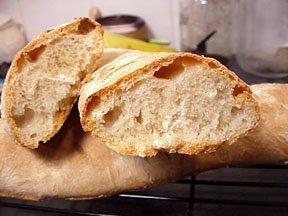
This morning I found a loaf of ciabatta bread left over from yesterday's lunch, so I have decided to make soup with it. This is a classic Tuscan housewife's recipe to use up stale bread and slightly over-ripe tomatoes. It is both simple and delicious. I first had it several years ago when on holiday in Lucca with old friends who are wonderful cooks, and it has become a family favourite.

PAPPA AL POMODORO: Tomato and Bread Soup

3 tablespoons olive oil
2-3 large garlic cloves, crushed to a paste with ½ teaspoon salt
750g ripe tomatoes, peeled and chopped (some like to deseed them as well)
200g of stale white bread, crusts removed, broken into pieces – do NOT use pre-packaged sliced bread it will go horribly slimy,
use country bread like ciabatta, bloomer, sourdough etc.
1 litre chicken or vegetable stock
10 -12 fresh basil leaves
Salt and freshly ground black pepper
~~~~~
Extra virgin olive oil, basil leaves, Parmesan shavings – for serving/garnish

Heat the olive oil in a large saucepan and sauté the garlic gently without letting it brown, then add the tomatoes, basil and bread (tear the basil leaves with your fingers, NEVER chop basil with a knife or scissors it changes the flavour). Add the stock, little by little, stirring and mashing the bread down until the mixture begins to resemble a porridge, pour in any remaining stock. Taste and season. Garnish with a swirl of olive oil, extra torn basil, and some shavings of Parmesan.
This can be served hot, warm or cold but I think it is at its best at room temperature on a hot day. It can be made a day ahead and reheats beautifully, but doesn't freeze well.

BTW the word "pappa" in the name of the soup doesn't have anything to do with dad, daddy, father - it means pap/puree/mush.