Showing posts with label apples. Show all posts

Tuesday, March 10, 2009


ANOTHER WONDERFUL EPITAPH - this one is to a man named Knott, and is from Bromsgrove in Worcestershire:


Here lies a man that was Knott born,

His father was Knott before him.
He lived Knott, and did Knott die,
Yet underneath this stone doth lie:

Knott christened,
Knott begot,
And here he lies,

And yet was Knott.


READING:


I have never been much of a short story reader.I don't really know why they don't
appeal to me now, when I was a girl I used to love reading them in my parents' copy of The Argosy (British version). Anyway, if I'd realised that Small Crimes in an Age of Abundance by Matthew Kneale was a collection of short stories I would probably never have bothered to pick it up in the library, let alone start reading it; it was only when I was a few pages into what I thought was the first chapter that it dawned on me, but by then I was hooked. In fact, like someone who opens a packet of biscuits intending to just eat one, I found myself staying up well past my bedtime so that I could scoff the whole lot.

The stories have a theme. In this inter-connected world the relationship between the haves (we in the west) and the have-nots has become increasingly complex and however well-meaning we may be as individuals, we can find ourselves complicit in situations of moral ambiguity which often have devastating effects on people on the other side of the globe. When is a crime a 'small' crime? after all, what is small to me may be very big to you - or should all crimes be considered equal?

'Stone' which is the first story illustrates this very well. It is of a comfortably off, middle-class English couple, Guy & Chloe Winter, and their two teenage children who go on a trip to China. At the end of the trip it is planned that they will go to Hong Kong where the Chloe has arranged a business meeting with a business man interested in buying her jewellery designs. Travelling with an organised tour group which transports them around the country to the main cultural destinations is not sufficient for their self image of being "travellers" rather than "tourists" so they have decided to leave the group for a few days and travel alone "to
meet people and get to know the REAL China,". Needless to say they do not speak Chinese or know anything of the culture, and phrase books fail to bridge the gap; it all goes awry when they meet up with a helpful, English-speaking young man called Jiao, who they nickname Eeyore. Jiao assists them in finding a hotel, getting a meal and doing some shopping but his presence begins to annoy the family. When Chloe can't find the box of her jewellery samples they feel sure that Jiao, being a poor man, must have stolen them. A huge fuss ensues, the local cops arrive, Jiao is carted off following their accusations. As things have turned sour, the Winters decide to leave the following day. Of course, it being China, a crime against tourists MUST be solved and a forced confession is extracted from Jiao. And theft is a capital offence. As they repack their bags, Chloe finds her box of jewellery which had been carefully hidden by herself in a small inner pocket. They debate going to the police to tell them but decide against it in case they are not allowed to leave immediately as planned. En route to the railway station they see Jiao with some other prisoners in the back of a truck, all with their confession boards hung round their necks, being taken out of the town. They know what his fate is likely to be, but close their eyes to it. Back in England the memory of their trip slowly fades and finally they see what happened as "something far away, that was not quite real and that could not touch them".

The stories are very well crafted, and Kneale has a light touch when pointing a moral finger. There is humour too, especially in the story about a London solicitor whose career has stalled and who finds a big bag of cocaine and a mobile phone, and becomes a drug dealer in his spare time. From the other end of the spectrum is the story of the Colombian family who are made destitute when their legitimate crops are destroyed by anti-cocaine spraying, the spraying being done at the behest of the western countries whose citizens buy the drug.

This collection reinforces that it is as important to think about what we are doing on a personal level as well as on a national one when it comes to how we interact with other peoples and countries.

Rated 3.5*


RANTING
:

OK - here's a question, what do you think has made the biggest contribution to the emancipation of women in the 20th Century?
Well, I know what the Pope thinks.


Last Sunday was International Women's Day so L'Osservatore Romano, the official Vatican newspaper, published an editorial stating that the modern washing machine had done
more to liberate women than anything else. Education, the vote, being able to work outside the home, legalised abortion and effective contraception such as the Pill and the condom (especially the last three) apparently count for nothing compared with the benefits conferred on us by the washing machine.

In some of the poorest countries in the world, where people live in shanties, child mortality rates are sky-high, and the Catholic Church has a huge presence, there are precious few washing machines around - not to mention the lack of safe and reliable water supplies to which such machines could be connected, and I very much doubt that any woman given a washing machine would suddenly find herself emancipated.
What would be really helpful for the women and girls in developing countries (and that means most of the women in the world) would be literacy programmes, work that brought in a living wage, the ability to prevent unwanted pregnancies, protection from life-threatening sexually transmitted diseases, equal rights with men. I am sure there are many Catholic priests working in such communities who would agree with me. But back at head office
, the Cardinals, Archbishops, Bishops, Priests and Prelates live in an ivory tower where the nuns who wash their robes and cassocks probably have had their lives made easier by the wonders of modern domestic machinery; therefore they assume it is true for all womankind.
Lordy, lordy, the Holy See (as it is called) doesn't have a bloody clue about life, women and the real world . From now on I am rechristening it The Holy-Can't-See-What's-Really-Going-On.


RECIPE:

After cooking for a family for umpteen years I have default recipes for certain things, recipes which are tried and tested, totally reliable and practically known by heart - so I tend not to experiment with new versions of dishes I make regularly. Recently I found a new recipe at the hairdressers - there I was, my head covered with foil packets, idly flipping through Hello magazine (what a guilty treat!) and I came across this recipe for an apple pie. How many Apple Pie recipes does one need in life? two, three, more? Well fortunately I decided to copy it down, and last weekend I made it - the DH has declared it the BEST apple pie he's ever had and has begged me to make it again. I will, and so should you, you won't be disappointed.


VIENNESE APPLE PIE

50g sultanas

3 tablespoons dark rum

225g plain flour

175g butter
50g ground almonds
175g caster sugar

Zest and juice of 1 lemon

1 large egg - separated

700g cooking apples, peeled, cored and sliced

50g sponge fingers, crumbled

25g roughly chopped walnuts

Half teaspoon ground cinnamon
1 tablespoon granulated sugar for topping.


Put the sultanas and rum into a small bowl and leave to soak for several hours or overnight.
Mix the flour and ground almonds together, then rub in the butter. ( I do all this in a food processor). Stir in 50g of the caster sugar and the lemon zest. Mix together the egg yolk and lemon juice and stir it into the dry ingredients to make a firm dough. Wrap the pastry in cling-film and chill in the fridge for 30 minutes. Pre-heat oven to 180'C/ Gas 4; grease and base line a 20cm (8") loose-bottomed sandwich tin. Put sliced apple into a bowl, add the remaining 100g caster sugar, walnuts, cinnamon, sponge finger crumbs and rum-soaked sultanas (plus any surplus soaking juices). Use a wooden spoon to gently stir everything together. Roll out two thirds of the pastry and line the prepared tin with it, allowing any excess pastry to hang over the edge of the tin. Spoon in the apple filling and press down firmly with the flat of your hand (which I trust is clean!). Roll out the remaining pastry and using the tin as a guide cut out a circle to form a lid. Place it on top of the filling, flip the excess pastry over it and roll or press gently to form a neat seam on top of the pie. Use a fork to whisk the egg white until frothy and then brush it over the top of the pie, sprinkle with the caster sugar. Bake for 30-35 minutes until the pastry is golden. Allow it to cool in the tin for 5 minutes before carefully pressing the loose-bottom of the tin up and gently sliding the pie onto a serving platter. Serve warm or cold with a dollop of whipped cream.

Wednesday, December 05, 2007

IT'S ALL THE FAULT OF JOHN CALCOTT HORSLEY OF TORQUAY - IN 1843
HE PRINTED THE FIRST CHRISTMAS CARD, AND HERE AM I, 164 YEARS LATER TRYING TO GET THIS YEAR'S BATCH IN THE POST ASAP.


READING:

Minette Walters is one of Britain’s best-selling crime/thriller writers, and I have enjoyed several of her books. They all fall into the psychological thriller genre, and The Chameleon’s Shadow is her most recent book, having been published in October this year, so it is not yet available in paperback.

It was rather coincidental that I picked this up at the library, just after having ranted in my last blog post about injured servicemen being abused at a local leisure centre. The main character in the book is a young army officer who has just been serving in Iraq. Lieutenant Charles Acland has survived a bomb on the road between Baghdad and Basra, the two soldiers under his command who were with him were not so fortunate; however Acland has been horribly injured, and therein lies the plot. From the moment he comes to consciousness in a British Military hospital it seems as if what has happened to him has changed his personality dramatically, and his behaviour becomes increasingly violent, anti-social and unpredictable particularly towards women.

Meanwhile, in London there have been a series of brutal murders. Several men have been violently battered to death, and the police are baffled. When Acland is eventually released from hospital, and is discharged from the army on the grounds of his disabilities, he gravitates to London where he eventually comes to the notice of the police and is linked with the latest in this series of killings following a violent altercation with a man in a pub. Could he have committed the murders ? can he control the rage boiling up inside him? I don’t want to give any spoilers here, suffice to say that the plot becomes increasingly complex and twisted, and the reader is never quite sure where it will go next.

What I found particularly interesting about this book was the first part when Acland is still in the hospital and having many sessions with the resident psychiatrist. Walters really makes the reader think about what can happen to young men (and women) who go to war, and how, if a career in the army (or any other of the forces) has been your life plan it is totally devastating when, in addition to disfiguring and handicapping injuries, that is taken away from you. Reading this I could see how it happens that many of the homeless people on the streets of Britain are ex-military.

Rated: 3.5*


RANTING:

Bear with me whilst I have a little rant about rape. Rape is a nasty word, a nasty word for a nasty deed. I can remember, as a girl, hearing it referred to as “a fate worse than death”, and maybe for some women that seems to be true. In real life, death is the only final fate, and therefore there can never be a fate that is ‘worse’ than death. But I digress….

The reason I want to rant about rape is because the government, in the person of the Solicitor General, Vera Baird, announced a week ago that they were not satisfied with the rate of convictions for rape in the UK and therefore they planned to implement certain measures to increase the conviction rate.

When first I read this proposal I thought ‘fine, ok, that seems sensible’; but then I started thinking about what was really being said.

In this country a person is innocent of a charge brought against him/her until they are PROVED guilty beyond doubt. So in the case of rape and the conviction rates, is the Government saying that they KNOW that all persons accused of this heinous crime are actually guilty but are not being convicted by the courts? Because that is the implication of their recent statements –which goes against everything that the law in this country has stood for – namely, presumption of innocence.

Of course I realise that to prove a case of rape is never easy. Usually it is the word of one person against another with no witnesses. So it is likely that there are cases where rapists manage to get themselves acquitted, and that is horrible. Horrible for the person who was raped, and potentially horrible for others who may then suffer the same fate if the rapist strikes again.

Never-the-less, we change the law at our peril.

The Government is concerned about the number of reported rapes which fail to lead to a conviction. This means that a low number of allegations of rape made to and recorded by the police actually end up with the rapist being found guilty in a court of law. This is not because the courts are any softer on alleged rapists than they ever were, but because many of the reported rapes never make it to court at all. Of those that do, the conviction rate is nothing like as low.

I suspect that these proposed changes are due to three things: (1) Emotion – rape is a very emotive issue; (2) Government obsession with ‘targets’ in all aspects of national life, and 3. a huge widening of the definition of rape in Britain.

It is true that most women who are raped (and it is usually women) are raped by someone they know, a friend, a family member, a work colleague, a neighbour. Or a woman may well be raped by her own husband.
But I have grave concerns about the new view that someone who goes out and gets themselves totally legless, so that they cannot recall whether or not they consented to sexual intercourse, should be able to then cry ‘rape’. They must carry some responsibility for what occurred, even if in retrospect they are shocked, appalled, ashamed or concerned.


RECIPE:

My DD is the muffin maker in our family, and has a huge repertoire of delicious muffin recipes; but from time to time I do venture into her territory, and last week when I had to take a contribution to a morning get-together I decided to try something new so made a batch of these. All I can say is that they vanished off the plate so fast I had hardly sipped my cappuccino before they were gone!

TOFFEE-APPLE MUFFINS

Makes 12

350g plain flour
2 tsp baking powder
2 tsp ground mixed spice (or cinnamon)
240g golden caster sugar
3 dessert apples, peeled, cored and finely chopped
3 large eggs, beaten
120ml vegetable oil
100ml milk
150g SOFT toffees, chopped into small pieces - it is essential to use soft toffees as hard ones take forever to chop up.

1 Preheat the oven to 180C and line a 12-hole muffin tray with paper cases. Sift the flour, baking powder and mixed spice into a large bowl and stir in the sugar. Make a well in the dry ingredients.

2 Add the chopped apples,toffee pieces, eggs, oil and milk in the middle of the well, and fold the mixture together with a large metal spoon, using as few strokes as possible. Don’t worry if the mixture is lumpy, the trick behind the lightest muffins is not to overwork the batter.

3 Fill the paper cases with the mixture, then bake for 25-30 minutes or until the muffins are well risen and golden.

Monday, November 20, 2006

DON'T COME TOO CLOSE, I'm absolutely streaming with cold and I wouldn't want you to get it. Honest to goodness, if they can put a man on the moon and invent the iPod shuffle you'd think some bright spark would have got the common cold under control by now.


READING:

How to waste an hour and a half looking something up.

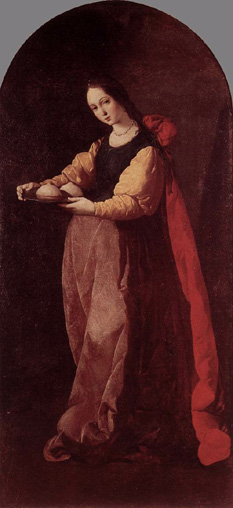
Like many other people I love almanacs, encyclopaedias and other reference books of that ilk. Yesterday I came across a classical reference in a novel I’m reading. Now I did do Latin until I was about 12, and have read (many moons ago) the Greek myths, but this was not a name that was familiar to me – Pylades – do you know who he/she is? Anyway, when I was having a mug of coffee at my desk, I thought I’d just look him/her up in my copy of Brewer’s Dictionary of Phrase and Fable. Big mistake, nearly two hours later I was still browsing through Brewer’s. First I found Pylades, turns out he was bosom friend of Orestes, so they hung out together like David and Jonathan; while I was at it, I thought I’d look up Eagle stones, which lead me to Aetites and then on the next page I spotted St Agatha –the patron saint of volcanoes, and who is depicted in paintings holding a platter with her severed breasts on it. This reminded me of a little Italian village we once visited, called St Agata Due Golfi which is just south of Vesuvius. My DH and I once had a fabulous dinner there at a restaurant called Don Alfonso 1890, which has 3 Michelin stars, and the bill nearly broke the bank.

Then I thought I would quickly look to see what Brewer said about Dick Whittington, because on Highgate Hill (which is nearby), he and his cat heard Bow Bells tell him to turn again – but there was nothing I didn’t already know. Then I started opening the book randomly, and discovered all sorts of fascinating titbits – the name of the Man Who Broke the Bank at Monte Carlo (Joseph Hobson Jagger); the smallest pig in a litter of piglets will reputedly follow its owner anywhere, and is known as a Tantony Pig, and a Wapentake is a subdivision of a county similar to the Hundreds or Ridings. Anyway, when the phone rang I suddenly realised how much time had passed and how totally absorbed I had become, what was I thinking of…and on a Monday morning too.

Every home should have a copy of Brewer’s Dictionary; it is an essential household requirement for settling arguments, solving crossword clues and general time wasting.

RANTING:

Time for another rant at the ludicrous use of Health & Safety legislation in this country.

Those of you who have or have had children may know of a famous fictional character called Postman Pat. A cheery chappie, he delivers the mail by driving his little red post van around country lanes, accompanied by his black and white cat Jess. There was a TV series, books, tapes and other toys based on Postman Pat, he is loved by thousands of British children.

For the last six years, a mechanised, coin-operated Postman Pat Post van ride has stood in a shopping precinct in Market Harborough. You know the kind of thing. Your 3 year old sits in the little rocket, car, train or whatever, you pop some coins in the slot, and the machine rocks gently back and forth. It is a welcome distraction when shopping with a young child.

Now the owners of St Mary’s Place Shopping Precinct have said it must go. A spokesman for St Mary's Place said it was targeting "material outside shop boundaries with health and safety implications." Not because the ride itself is considered dangerous – rides already have to comply with stringent H&S guidelines regarding manufacture and maintenance. No, they think it might be a H&S risk for pedestrians. The fact that this particular ride has stood in the same position outside a particular shop for the past six years without one single person walking into it or tripping over it, (in fact there has never been any man, woman or child involved in any sort of incident with the ride) would seem to contradict their views.

So why this sudden anxiety? Well, one of two reasons I suspect. Either the local council’s Health & Safety gaulieters have decided to justify their jobs by scratching around for something to have a go at, and have been all over the owners of St Mary’s Place like a rash OR the owners of St Mary’s Place want some more money from the shop owner who owns the ride, and this is part of a softening up process to get it. Or maybe it’s a bit of both. Whichever it is, Health & Safety is again being cited as the reason. Soon we’ll be fined if we don’t tie our shoelaces to their satisfaction.

Welcome to the house of fun.


RECIPE:

How to satisfy a craving for something sweet to eat when there isn't a biscuit in the house, you havn't been to the shops yet and the fruit bowl only contains two rather elderly cooking apples...throw together this little number, it takes no time at all, and hey presto, sweet craving satisfied.

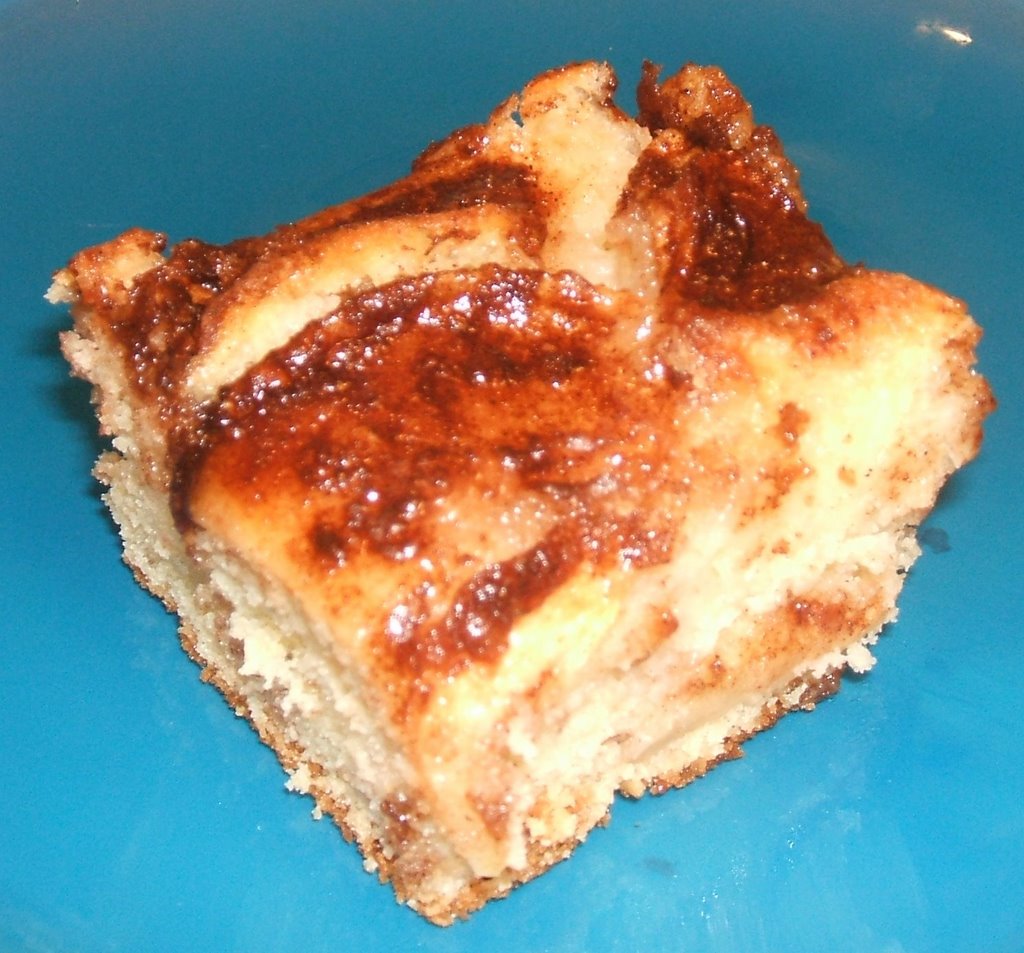
DUTCH APPLE CAKE

170g self-raising flour
1 large egg

1 teaspoon baking powder
85g caster sugar
6 tablespoons milk

28g melted butter (do this in the microwave)

For the topping

28g melted butter
85g caster sugar
1 level teaspoon cinnamon
500g cooking apples

Pre-heat oven to 200°C

Line rectangular baking tin (28 cms x 18cms) with baking paper.
Sift flour, baking powder together into a bowl, add the sugar and stir in.
In a jug mix the egg, milk and melted butter together.
Mix the sugar and cinnamon for the topping together in a small bowl.
Peel and core and quarter the apples, and cut into slices.
Pour the egg mixture into the flour and using a wooden spoon mix well to form a stiff batter.
Spoon the batter into the prepared tin and spread it evenly – it will seem a very thin layer.
Brush the batter with the melted butter for the topping and then arrange the apple slices neatly over the surface in overlapping rows.
Finally, sprinkle the mixed sugar and cinnamon evenly all over the apple slices.

Bake for approximately 30mins until risen and golden.

Cool, and then cut into squares.


Saturday, October 21, 2006

SEASON OF MISTS AND MELLOW FRUITFULNESS
Close bosom-friend of the maturing sun;
Conspiring with him how to load and bless
With fruit the vines that round the thatch-eves run;
To bend with apples the moss'd cottage-trees,
And fill all fruit with ripeness to the core;


READING:

I try to read all new South African fiction I can lay my hands on, and now have amassed quite a collection; The Smell of Apples by Mark Behr is a book I read several years ago, but as I seem to have a theme going in this post, I thought it would be appropriate to tell you about it now.

The novel covers a relatively short time-span in the last weeks of 1973, and is told by Marcus the 11 year old son of a senior South African army officer. His family are Afrikaners - very much part of the ruling elite - and totally committed to the concept of apartheid, and convinced of their own superiority over other peoples. When a visitor from abroad enters their home things begin to seem different, Marcus begins to become aware of apartheid's twisted logic, and nothing will ever be the same for him. This is a very subtle depiction of a child's introduction to hypocracy, and a piercing indictment of the Afrikaner mentality which underlined the creation of the racist state. The book won the Eugene Marais Prize from the South African Academy of Arts and Science, and it also won the CNA Literary Debut Award; both awards are well deserved.


RANTING:

Every day it seems this bloody government comes up with some new statement about how we should live our lives. I am fed up to the back teeth with it all. Frankly, as long as we are not doing anything illegal and are paying our taxes, it is none of their business how we walk, talk, think, fart, read, work, sleep, drink or clean our teeth.

One of the latest areas of private life into which the Nanny State has decided to meddle is to worry about our body size and what we eat. Ms Caroline Flint - who she you ask? the new Minister for Fitness (did you know we had one of those? neither did I) - has made a statement urging supermarkets to give us all lessons on how to eat fruit and vegetables because "many people find fruit and vegetables scary". Oooh how true, I'm terrified of runner beans, and don't even mention pineapples to me......

For pity's sake, the population know all they want to know about fruit and veg, and what is good for you they don't need to be told by some patronising Nu-Labour bimbo, after all hadn't she ever heard the old English rhyme:

An apple a day keeps the doctor away
Apple in the morning - Doctor's warning
Roast apple at night - starves the doctor outright
Eat an apple going to bed - knock the doctor on the head
Three each day, seven days a week - ruddy apple, ruddy cheek


Ruddy cheek, I think that sums Ms Flint's comments up nicely.


RECIPE
:

According to some Fruity PR person, October 21st is 'Apple Day', well I'll go along with that. We eat loads of apples, in fact we have two old apple trees in our postage stamp sized garden here in north London. Sad to say, the few apples they produce are not much cop. I have tried umpteen ways of using them over the years, but have finally given up and leave them to the birds and the squirrels. I do try to buy English apples, there are so many lovely varieties such as Worcester Pearmain, Egremont Russet, the delicious Cox's Orange Pippen and the queen of cooking apples, the Bramley; it is always a joy when they are available rather than the three or four internationally grown varieties stocked by most supermarkets


CHICKEN BREASTS WITH APPLES & THYME

175g onion, finely chopped
50g butter

2 crisp dessert apples (coxes are ideal), peeled and grated
50g mature Cheddar cheese, grated
40g fresh breadcrumbs (brown or white)
2 level tablespoons fresh thyme, finely chopped (or 1 teaspoon dried thyme).
Salt and pepper
4 large chicken breasts WITH skin on (approx 700g total weight)
75ml apple juice or cider
4 level teaspoons cornflour
300ml chicken or vegetable stock
1 tablespoon wholegrain mustard


Heat half the butter in a pan and sauté the chopped onion until softened, cool.
Add the grated apple and grated cheese to the cooled onion and mix well.
Add the breadcrumbs, thyme and seasoning.

Loosen the skin of the chicken and push the stuffing underneath, pressing into place.
Put the stuffed chicken breasts into a roasting tin and dot with the remaining butter and season with salt and pepper; pour the apple juice/cider over the chicken.

Cook at 190°C for about 50 minutes until the chicken is cooked through. Remove the chicken from the roasting tin and keep warm.

Blend the cornflour with 2 tablespoons cold water and add to the pan together with the stock and the mustard. Bring to the boil, stirring constantly, and cook for 2-3 minutes until slightly thickened. Check seasoning. Pour over the chicken breasts.

Serve with green vegetables and creamy mashed potato.

You can prepare this recipe ahead, cover and refrigerate for up to 24 hours, then cook the chicken and make the sauce when you are ready.